Every November, shoppers hit “Notify me when available” more often than at any other time of year. To show merchants how big that wave is and when it hits, we looked at five years of back-in-stock requests made through Notify Me! on Shopify stores, from 2021 to 2025. Each Black Friday Cyber Monday (BFCM) is compared with the same store base in the October before it. All charts on this page are interactive: hover, switch years and toggle series.
The headline numbers
- 1.57×: average back-in-stock requests per day over Cyber 5 (Thanksgiving through Cyber Monday) compared with an average October day, across 2021–2025.
- #1: Black Friday was the single busiest day of the entire year for back-in-stock requests in 2022, 2023, 2024 and 2025.
- 5 for 5: Black Friday drew more requests than Cyber Monday in every year we measured.
- −46%: how far restock alerts dropped on the Cyber 5 weekend in 2025, while shopper demand did not drop at all.
- 46%: share of Cyber 5 2025 requests that were never restocked within 90 days.
1. Cyber 5 Brings 1.6× More Out-of-Stock Demand
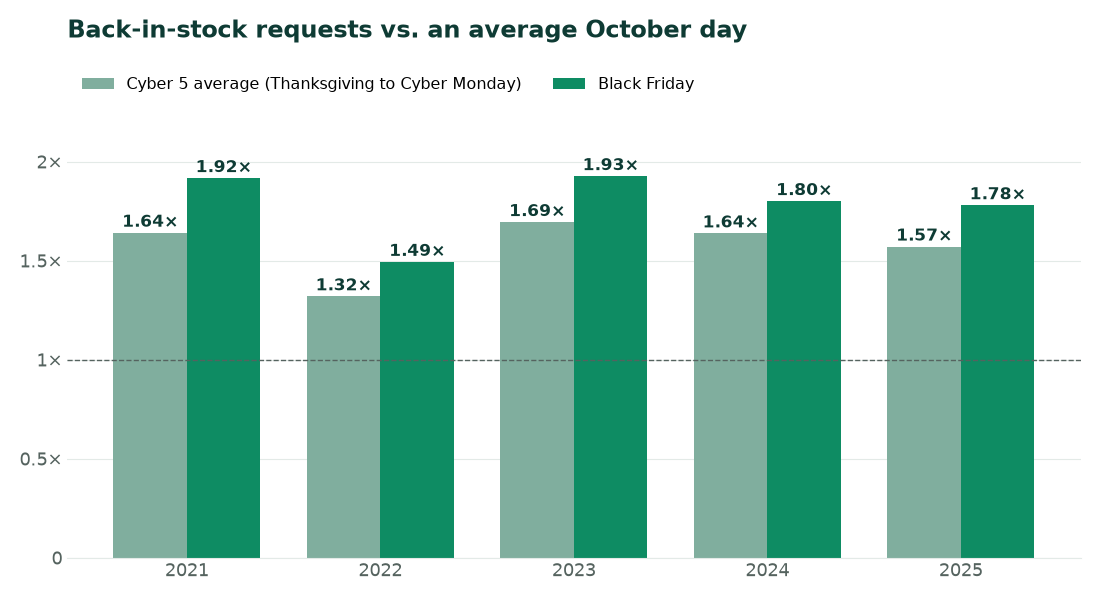
Daily back-in-stock requests on Cyber 5 (average) and on Black Friday, divided by the average October day of the same year.
Insights
- A consistent wave: Over Cyber 5, stores received between 1.32× and 1.69× their October request volume every year. The five-year average is 1.57×.
- Black Friday is the peak: On Black Friday itself requests reach 1.49× to 1.93× an October day. In 2025 that meant 69,657 requests in a single day.
- Black Friday beats Cyber Monday: Cyber Monday is big, but it has finished behind Black Friday every year since 2021. In 2025 it reached 61,622 requests, about 12% fewer than Black Friday.
- Thanksgiving counts too: Thanksgiving Day itself already runs about 1.4× October (2023–2025), as shoppers browse deals before the doors open.
- It’s per store, not just more stores: A store that receives requests gets about 40% more of them per day during Cyber 5 than in October (2023–2025). The growth is not just more stores joining in.
The pattern is remarkably stable. Line the five years up so that Black Friday is day 0, and the curves nearly sit on top of each other:
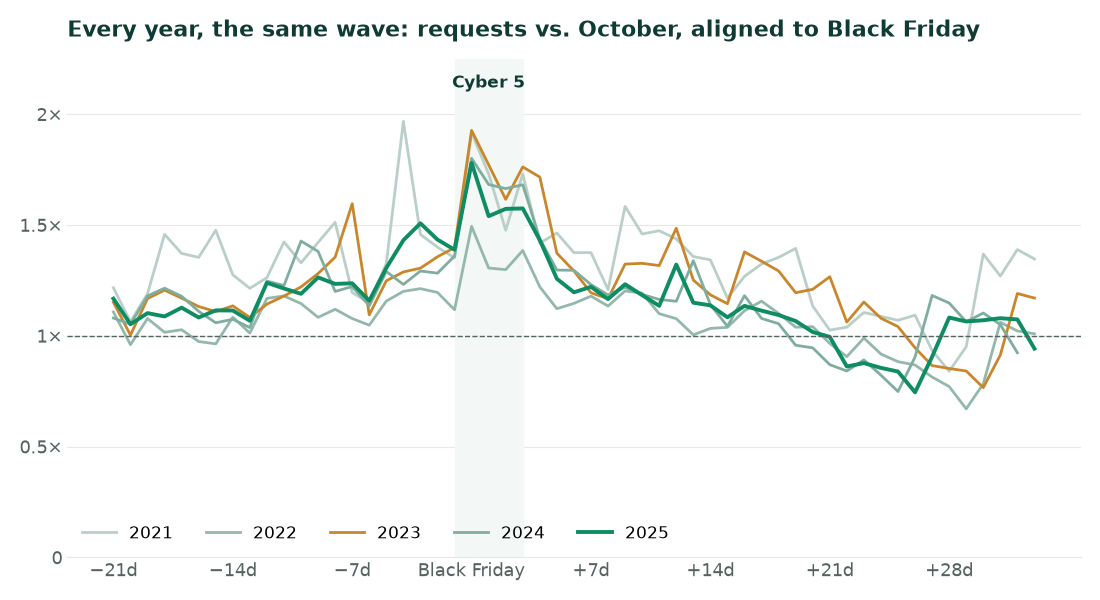
Daily requests divided by each year’s October average, aligned to Black Friday. The jump around +28 days is December 26.
What this means. Plan for roughly 1.6× your normal out-of-stock demand across the Cyber 5 weekend, with Black Friday as the peak. If a product sells out on Black Friday, the waitlist it builds that day is the biggest one it will get all year.
2. Demand Doesn’t Rest on the Weekend. Restocking Does.
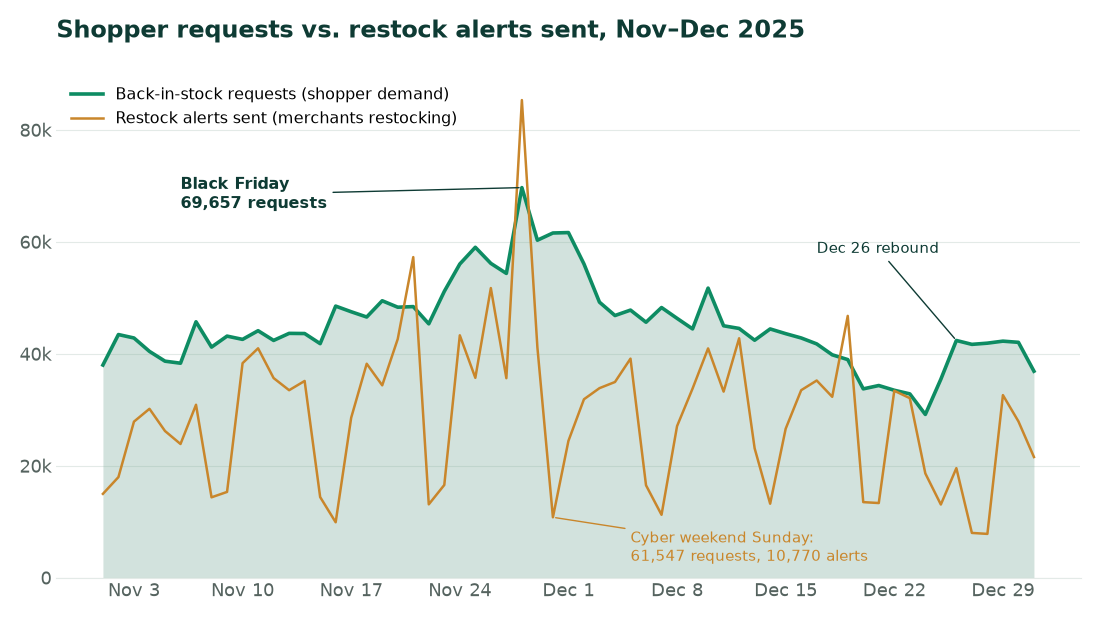
Daily back-in-stock requests (shopper demand) and restock alerts sent (products coming back in stock), Notify Me! stores, October–December. Switch years to compare.
Insights
- Restocks lag demand: From 2023 to 2025, requests over Cyber 5 averaged 1.63× October, while restock alerts sent averaged only 1.24×. Shoppers ask for sold-out products far faster than they come back.
- The Black Friday restock push: Merchants do restock for the big day. Black Friday 2025 was the busiest restock day of the season, with 85,287 alerts sent.
- Then the weekend gap: On the Cyber 5 weekend of 2025, alerts sent fell 46% compared with the weekdays around it, while requests stayed just as high. On Sunday, November 30, shoppers made 61,547 requests and stores sent just 10,770 alerts.
What this means. The weekend after Black Friday is when demand is high and restocking is slow. If you can receive stock, adjust inventory or move units between locations over that weekend, do it. Make sure alerts go out automatically when stock lands, not when someone gets back to the office. Our restock speed data shows that half of restock purchases happen within 2.3 hours of the alert, and products restocked within 24 hours convert 18.3% of waiting shoppers.
3. The Wave Starts a Week Early and Lasts a Week Longer
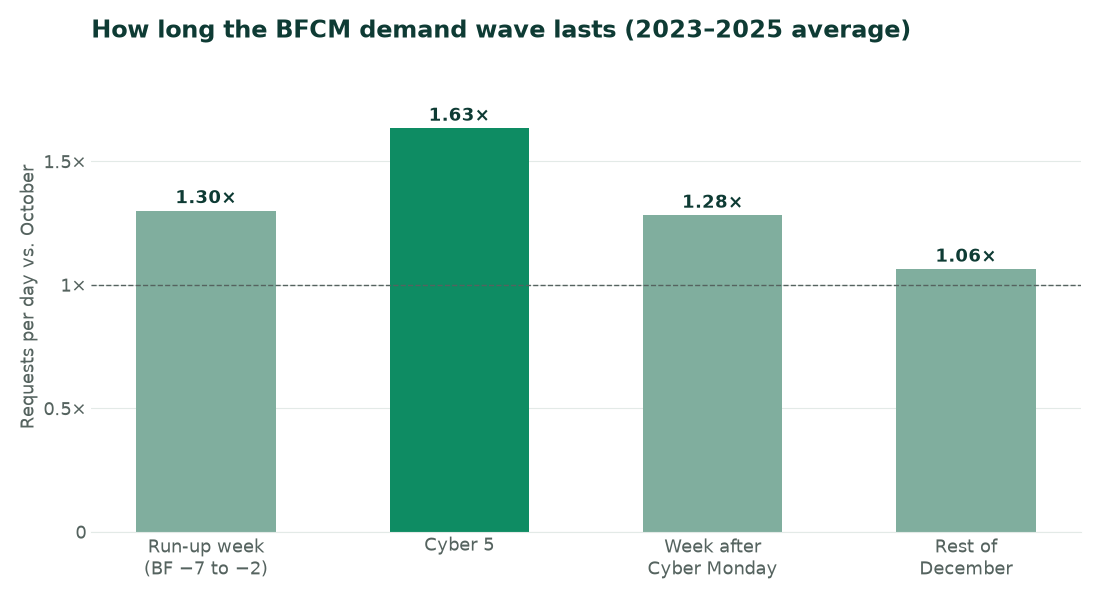
Average daily back-in-stock requests in each part of the season, divided by the same year’s October average.
Insights
- The run-up week: In the six days before Thanksgiving, requests already run 1.30× October, as early deals sell through and shoppers start building lists.
- The week after: Demand stays at 1.28× October in the week after Cyber Monday. The season does not end on Monday night.
- The December fade: For the rest of December, requests fall back to near October levels (1.06×) and hit their low on Christmas Eve.
- The Boxing Day rebound: Requests jump 45–63% from December 24 to December 26 every year, as gift cards and post-holiday sales bring shoppers back to sold-out products.
What this means. Treat BFCM as a three-week event, not a four-day one. Get your back-in-stock and preorder buttons live before the run-up week. Keep restocking through the first week of December, and plan a December 26 restock for your best sellers.
4. Almost Half of BFCM Waitlists Are Never Restocked
The waitlists built over Cyber 5 are the biggest of the year. So what happens to them? We followed every request made over Cyber 5 for 90 days.
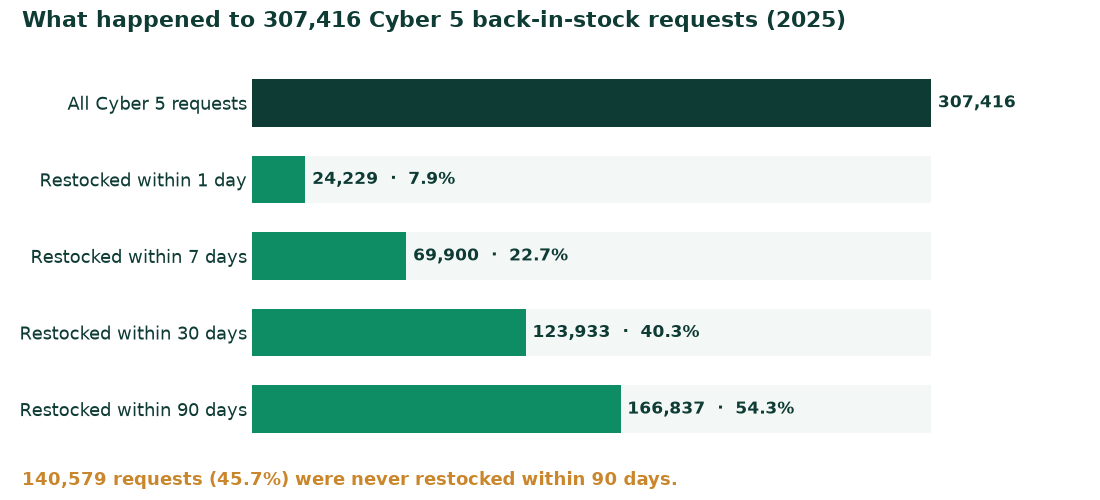
Requests made over Cyber 5, followed for 90 days.
Insights
- Fast restocks are rare: Only 7.9% of Cyber 5 2025 requests were restocked within a day, and 22.7% within a week.
- Most of the rest wait weeks: 54.3% were restocked within 90 days. That leaves 140,579 requests, or 45.7%, that were never restocked in that time.
- The leak isn’t unique to BFCM: October requests restock at almost exactly the same rate (54.6% within 90 days in 2025). BFCM doesn’t make the leak worse. It makes the waitlist 1.6× bigger, so the same leak costs more.
What this means. A waitlist is only revenue if the product comes back. Before BFCM, look at which of your products already have the longest waitlists, and decide now whether you’ll reorder them, offer them as a preorder, or point waiting shoppers to an alternative. Shoppers who joined a waitlist on Black Friday are still interested in December, but only if you restock while they still care.
5. Plan Your Own BFCM Waitlist
With JavaScript turned on, this section estimates your store's BFCM back-in-stock requests from your October average. As a rule of thumb: Thanksgiving ≈ 1.4× an October day, Black Friday ≈ 1.8×, Cyber Monday ≈ 1.7×, and the 18 days from the run-up week through the week after Cyber Monday ≈ 25 October days of demand.
Your BFCM Back-in-Stock Checklist
- Turn on back-in-stock alerts before November 20 so the run-up week’s demand is captured, not lost.
- Stock for Black Friday first. It has beaten Cyber Monday for five years straight.
- Plan a weekend restock. The Saturday and Sunday after Black Friday have Black Friday-level demand and half the restocks.
- Automate the alert. Shoppers buy within hours of the alert, so send it the moment stock lands.
- Decide what happens to every long waitlist. Reorder it, switch it to preorder, or suggest an alternative. Don’t let it expire.
- Restock bestsellers for December 26.
The bottom line. Black Friday has become the single biggest day of the year for shoppers asking to be told when a product is back. Stores that restock quickly, including over the weekend, and alert waiting shoppers automatically get a second chance at sales most stores lose.
Methodology
This report uses anonymized, aggregated data from Shopify stores using Notify Me!, 2021–2025. A “request” is a shopper subscribing to a back-in-stock alert for an out-of-stock product. Imported subscriber lists are excluded. A “restock alert sent” is a back-in-stock notification sent when the product became available again. Each year is compared with the October of the same year, so changes in the number of stores using the app do not inflate the multiples. Cyber 5 runs from Thanksgiving Day to Cyber Monday (2025: November 27–December 1). The run-up week is the six days before Thanksgiving, and the week after is the seven days after Cyber Monday. The 90-day funnel follows each request from the moment it was made. Days are UTC calendar days. The Cyber 5 2025 replay at the top of the page uses hourly UTC totals, country shares use each store’s country, and the pings on the globe are illustrative. Store-level data is never shared. All figures are aggregates.
Journalists and newsletter writers are welcome to cite these figures and embed the charts with a link to this page. For questions or additional cuts of the data, contact marketing@notify-me.io.