
Restock demand is perishable. Shoppers who ask to be notified about an out-of-stock product are highly motivated — but that motivation decays with every day the product stays unavailable. We measured every timestamp in the back-in-stock journey over the last 12 months: how long shoppers wait, and how fast they act once the alert arrives.
1. Shoppers Act in Hours, Not Days
The moment a back-in-stock alert is delivered, the clock effectively stops mattering — because buying happens almost immediately.
Insights
- The two-hour window: Half of all restock purchases happen within 2.3 hours of the alert, and a quarter within just 17 minutes.
- Same-day decisions: Three quarters of purchases land within a day of the notification; by day five, 95% of the purchases that will ever happen already have.
- The full journey: The median request-to-purchase journey runs 7.5 days end to end, almost all of it spent waiting for the restock, not deciding whether to buy.
What this means. The alert moment is the buying moment. Make sure alerts fire automatically the second inventory lands, and that the product page is live, priced, and ready to buy when they do. A delayed or manual alert doesn’t push the sale back — it usually loses it.
2. Every Day of Delay Costs Conversion
How fast the product comes back is the single strongest conversion lever we found in the entire dataset.
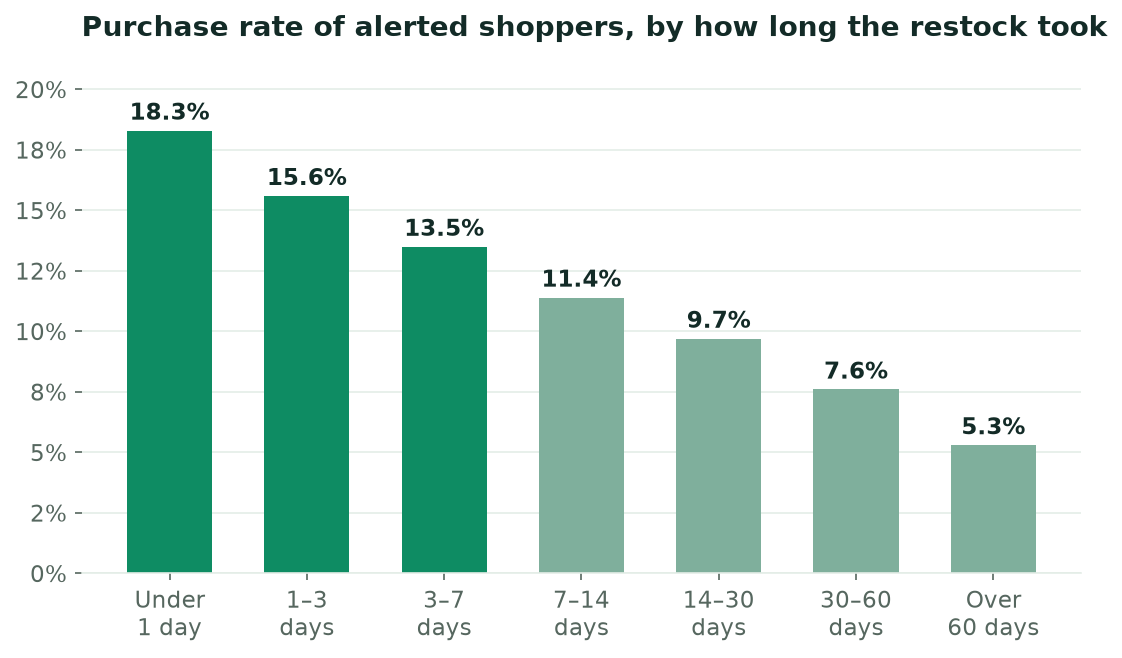
Purchase rate of alerted shoppers by time from request to restock. July 2025 – March 2026 cohorts, 90-day windows.
Insights
- Restock within 24 hours: 18.3% of alerted shoppers buy — nearly one in five.
- Within the first week: Conversion holds strong at 13–16%.
- After two weeks: Conversion slips below 10%, and products that take more than 60 days convert at just 5.3%.
- The spread: A product restocked within a day converts 3.4× better than one restocked after two months.
What this means. Give waitlisted SKUs priority in your restocking plans. A product with fifty shoppers queuing that you restock this week converts roughly one in seven of them; the same restock two months out converts one in nineteen. Speed isn’t a nice-to-have — it’s the difference between recovering demand and archiving it.
The bottom line. Back-in-stock shoppers reward speed twice: they buy at much higher rates when the restock is fast, and they finish the purchase within hours of hearing about it. Build your restocking rhythm around the waitlist, and let the alerts do the rest.