
Preorder takes the same demand signal as back in stock and flips it to before launch: sell the product while the inventory is still on a boat, in production, or in a spreadsheet. Over the last 12 months, 5,560 stores took 569,000 preorders through Notify Me!, booking $63.6 million in sales — up 41% year over year. The economics are worth a close look.
1. Preorder Shoppers Pay in Full
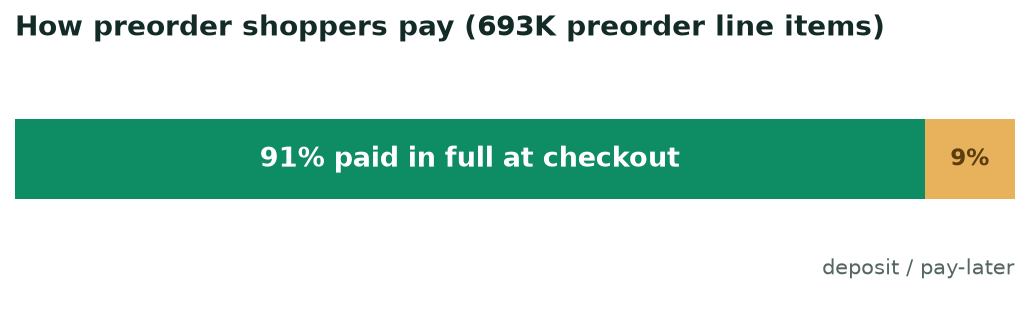
Payment status at purchase across 693K preorder line items, July 2025 – June 2026.
Insights
- Cash up front: 91% of preorders are paid in full at checkout; only 9% use a deposit or pay-later arrangement.
- Order values: The median preorder is $87 (average $167), indistinguishable from a regular restock order — for a product that doesn’t exist yet.
What this means. Preorders are working capital. Merchants collect the revenue weeks before the inventory arrives, which means launches can partly fund their own production runs. If cash flow is the constraint on your next drop, preorder is the tool built for it.
Commitment That Holds
Insights
- Cancellation rate: Just 0.7% of preorders are ever cancelled — roughly 1 in 140.
- Why it matters: Shoppers who commit to waiting stay committed. Preorder demand is firm demand, not a soft reservation.
What this means. Honor the trust that number represents: publish honest delivery windows and keep preorder buyers in the loop. The data says shoppers will wait, as long as they know what they’re waiting for.
A Launch Tool That Becomes a Channel
Insights
- Most stores start small: The median preorder store does 5 preorders a year — a launch tool used in bursts.
- The leaders run it continuously: The top decile takes 185+ preorders and $18,000+ per year; the top 1% books $244,000.
- Season matters: A third of all preorder revenue lands in Q4 (October–December), as stores pre-sell holiday inventory before it arrives.
What this means. Start with one launch and measure it. The stores at the top of this curve began the same way, then made preorder a rhythm. And plan your Q4 preorder calendar by September: the quarter where inventory risk is highest is exactly where pre-sold demand pays best.
The bottom line. Preorder pairs the conversion certainty of a committed buyer with the cash-flow profile of an advance. With 91% paying up front and fewer than 1% cancelling, the risk sits almost entirely where it should: on the calendar, not the customer.