
Updated July 2026. All figures reflect the latest 12 months of Notify Me! platform data, July 2025 – June 2026. Times are store-local market time, approximated by store country.
Effective inventory management is essential for maximizing sales and ensuring customer satisfaction. One critical aspect is determining the best times to restock products. Based on a full year of restock and conversion data, this update highlights the optimal days and hours for restocking — and revises some of our earlier advice.
1. Best Days to Restock a Product
Analyzing restocking volume and conversion by day of the week reveals patterns most operations calendars miss.
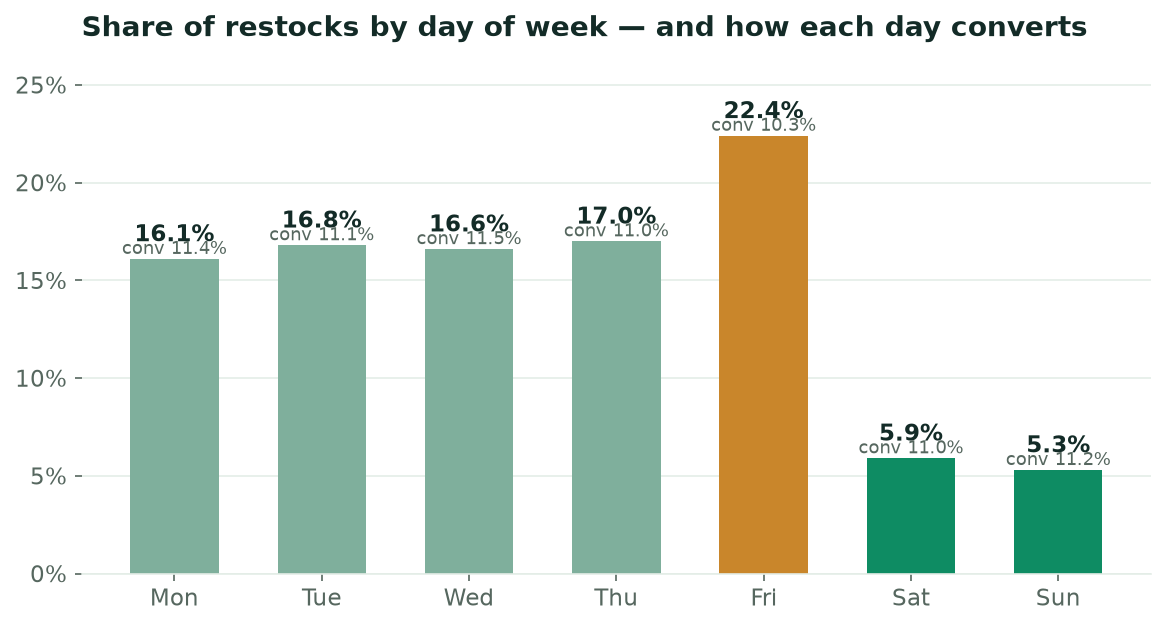
Each day’s share of all restocks, with the purchase rate of shoppers alerted that day. July 2025 – March 2026 cohorts.
Insights
- The Friday pile-up: 22.4% of all restocks happen on Friday, by far the biggest day — yet Friday restocks convert worst (10.3%), since alerts land just as shoppers head into the weekend and decisions get put off.
- Weekends are underused: Saturday and Sunday together get just 11% of restocks while generating 28% of shopper requests, and weekend restocks convert perfectly well (11.0–11.2%).
- Midweek quietly wins: Monday and Wednesday restocks lead conversion at 11.4–11.5%.
What this means. Don’t let your restocking calendar stop on Friday afternoon. Spreading restocks into the weekend — or simply moving the Friday batch to Monday morning — puts your alerts in front of shoppers when they’re buying, not when they’re logging off.
2. Best Hours to Restock a Product
Within the day, when inventory goes live determines when the alert lands — and the alert moment is the buying moment: half of all restock purchases happen within 2.3 hours of the notification.
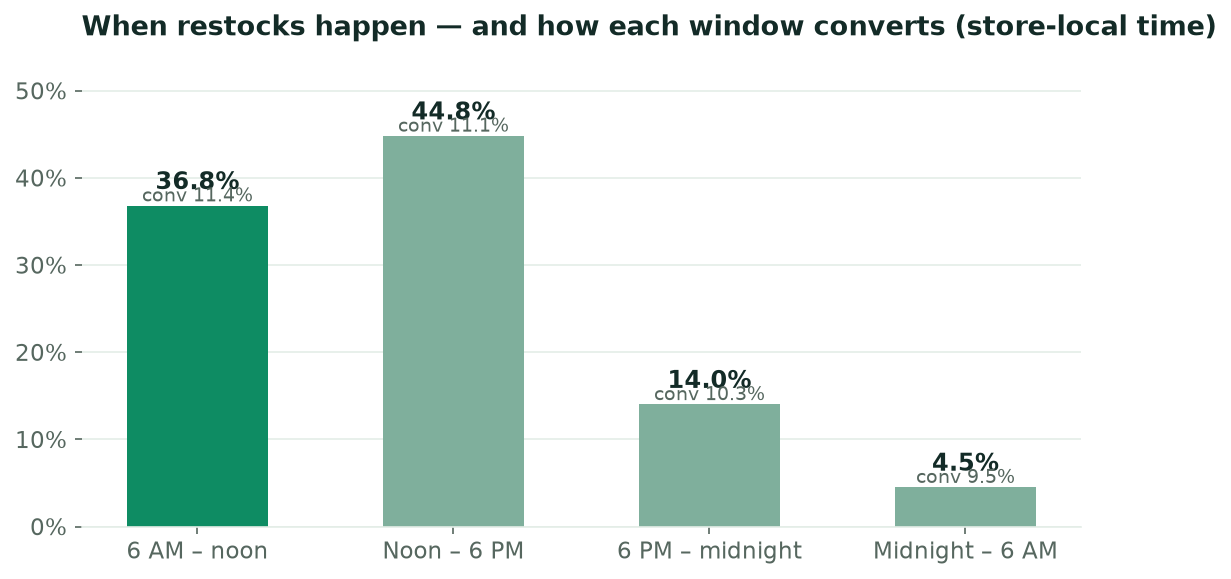
Share of restocks by time-of-day window, with the purchase rate of shoppers alerted in each window.
Insights
- Business hours dominate: 81.6% of restocks happen between 6 AM and 6 PM store-local time; only 4.5% happen overnight.
- Morning is the sweet spot: Restocks that go live between 6 AM and noon convert best, at 11.4%, since the alert rides the entire shopping day, including the 8–10 PM browsing peak.
- Late restocks pay a toll: Evening restocks convert at 10.3% and overnight restocks at 9.5%. Shoppers wake up to a buried notification instead of a fresh one.
What this means. Make restocking the first task of the morning, not the last task of the day. A product that goes live at 9 AM gets its alert opened, clicked, and bought the same day; the same product restocked at 9 PM starts out at the bottom of an overnight inbox.
The bottom line. A year of conversion data sharpens the earlier advice: restock in the morning, spread volume across the week including weekends, and avoid the Friday pile-up. Lining up your restocking with when shoppers actually buy, rather than when the operations calendar ends, improves fulfillment rates, cuts stockouts, and captures demand at its freshest.