
Updated July 2026. All figures reflect the latest 12 months of Notify Me! platform data, July 2025 – June 2026.
Understanding customer behavior around out-of-stock requests is crucial for eCommerce businesses aiming to optimize inventory management and sales strategies. This report examines two key behavioral patterns: how quickly purchase intent decays after a request, and how long customers are willing to wait before the demand is effectively lost.
1. Tendency to Buy After Request
The critical behavior we track is the relationship between how long a shopper waits for a restock and their likelihood of buying once notified. The data shows a striking split between attention and intent.
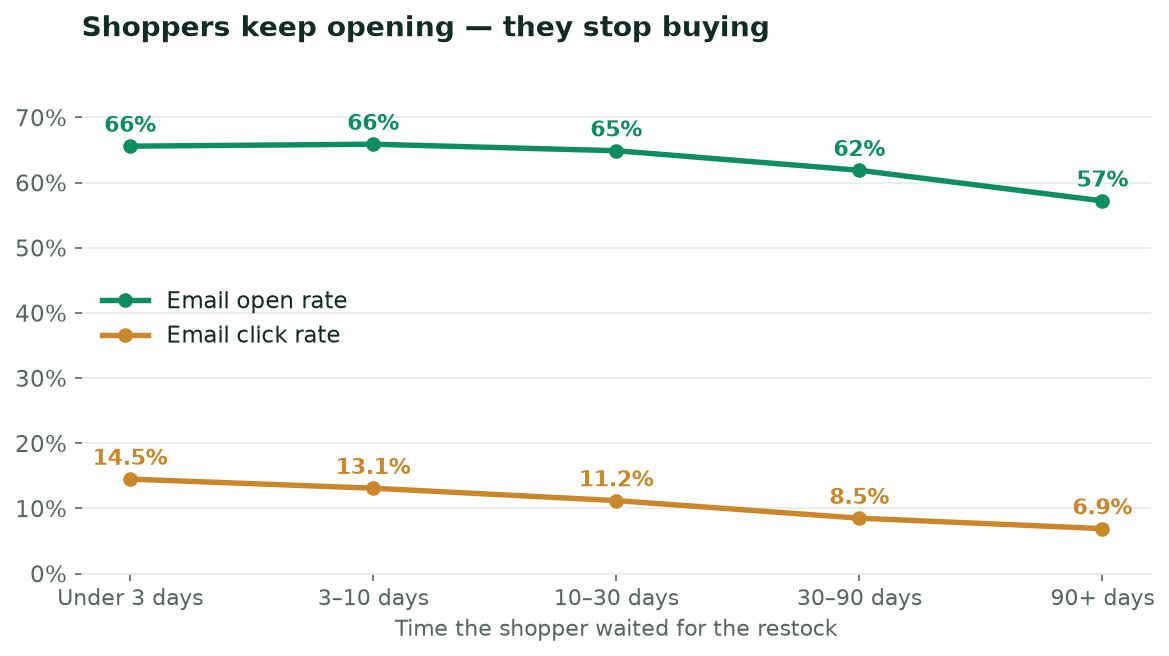
Email open and click rates by how long the shopper waited for the restock. July 2025 – March 2026 request cohorts.
Insights
- Purchase intent fades fast: Shoppers whose product returns within a day buy at 18.3%. By 30–60 days the rate is 7.6%, and past 60 days just 5.3% — a drop of more than 70%.
- Attention fades slowly: Email open rates barely move — 66% for restocks within three days and still 57% after 90 days, a relative decline of only about 13%.
- The gap is the real story: Click rates halve (14.5% → 6.9%) as the wait grows. Customers keep opening your alerts; they’ve simply moved on from buying.
What this means. The urgency belongs in restocking, not in re-sending. Try to restock requested products within the first ten days. After that, the shopper who still opens your emails isn’t waiting for this product anymore — but they’re still listening, which makes them a prime audience for alternatives.
2. How Long Will Customers Wait?
Since waiting tolerance can’t be negotiated, the practical question is where the cutoff sits: after how long does a restock stop producing meaningful sales?
Insights
- The conversion window: Half of all back-in-stock purchases come from restocks that happened within about a week of the request; two thirds within two weeks.
- The long tail is thin: Restocks arriving after 60 days produce fewer than 9% of all conversions, at less than a third of the conversion rate of fast restocks.
- The typical wait: The median successful restock takes 12 days from request to availability — fast enough that most shoppers are still engaged when the alert lands.
What this means. Treat 60 days as your practical deadline. Inside it, prioritize restocks by queue size. Beyond it, stop planning around the original sale: notify waiting customers about comparable products instead, and reclaim the demand before it fully expires.
The bottom line. Purchase likelihood drops sharply over time while attention lingers, which makes timely restocks — not repeated messaging — the lever that matters. Once you know where the conversion window closes, you can put replenishment where it still pays off and redirect demand where it doesn’t, capturing conversions while keeping customer trust.