
When a product sells out, the demand for it doesn’t disappear — it just becomes invisible to most stores. Every “notify me when available” click is a shopper volunteering purchase intent on an item you cannot currently sell. To measure exactly what that intent is worth, we followed 11.2 million back-in-stock requests placed across 20,600+ stores using Notify Me!, tracking each request for a full 90 days: did the product come back, did the shopper get alerted, and did they buy?
1. From Request to Restock
The first stage of the funnel has nothing to do with your customers — it depends entirely on whether the product returns to your shelves.
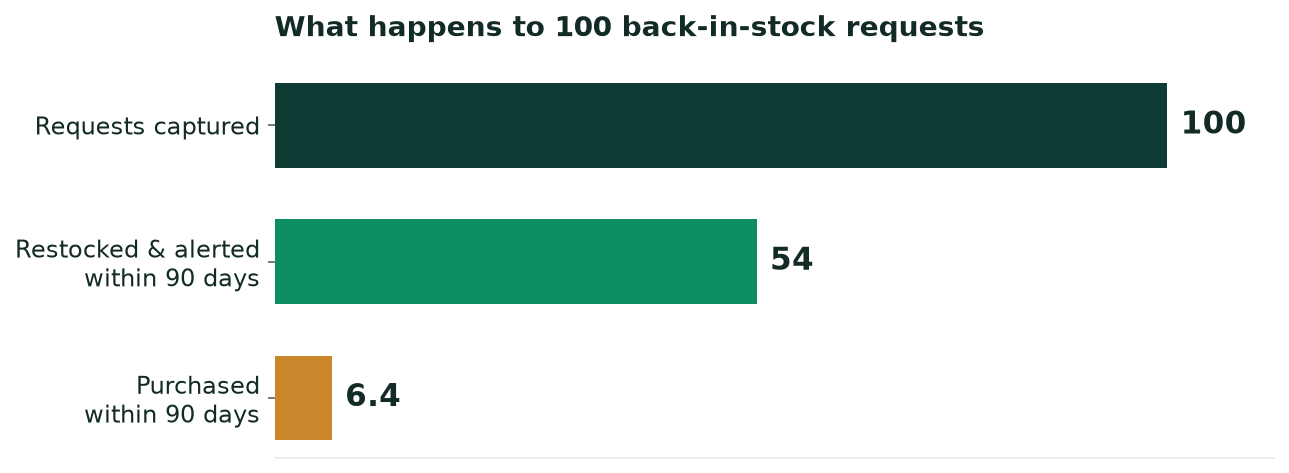
Request cohorts July 2025 – March 2026, each observed for 90 days. Notify Me! platform data.
Insights
- Restock rate: For 54% of requests, the product gets restocked and an alert goes out within 90 days of the request.
- The wait: The typical shopper waits 12 days for a restock. A quarter of restocks land within 3.4 days, but another quarter take more than five weeks.
- Lost demand: 46% of requests never get a restock inside the 90-day window. Each one is a shopper who put their hand up and never heard back.
What this means. Your waitlist isn’t a mailing list — it’s a live demand report on the products you’re currently out of. Read those request counts as restocking signals: products with a line of waiting shoppers should move to the top of your reorder schedule, because nearly half of all requested products never make it back at all right now.
2. From Alert to Order
Once the alert lands, the funnel becomes a conversion story — and the rates are far higher than almost any other form of marketing.
Insights
- Alerted-shopper conversion: 11.8% of shoppers who get a back-in-stock alert buy the product within 90 days of their request.
- End-to-end conversion: 6.4% of all requests turn into purchases — a figure that includes every product that never got restocked.
- Value per request: Across the whole funnel, every request captured is worth roughly $10 in recovered sales, and every alerted shopper roughly $19.
What this means. At these rates, every 1,000 back-in-stock requests add up to about $10,000 in recoverable revenue. Size your restocks against the queue: the waitlist tells you not just what to reorder, but how much of it you can expect to sell.
The bottom line. The back-in-stock funnel leaks in two places: supply (46 of every 100 requests never restock) and conversion (88 of every 100 alerted shoppers don’t buy). The first leak is the bigger one, and it’s entirely in your hands. Stores that treat their waitlist as an inventory planning tool, not just a notification feature, capture demand their competitors never even see.